Payout
A payout allows the transfer of funds to PaysafeCard account holders. Payouts are initiated by the business partner upon the customer’s request and can only be executed for customers who hold a PaysafeCard account.
Payouts are available exclusively to PaysafeCard account holders in the following countries:
| Argentina | Austria | Belgium | Bulgaria | Croatia | Cyprus |
| Czech Republic | Denmark | Finland | France | Germany | Greece |
| Hungary | Ireland | Italy | Latvia | Lithuania | Liechtenstein |
| Luxembourg | Malta | Netherlands | Norway | Poland | Portugal |
| Romania | Slovakia | Slovenia | Spain | Sweden | Switzerland |
| United Kingdom |
End‑to‑End Payout Flow
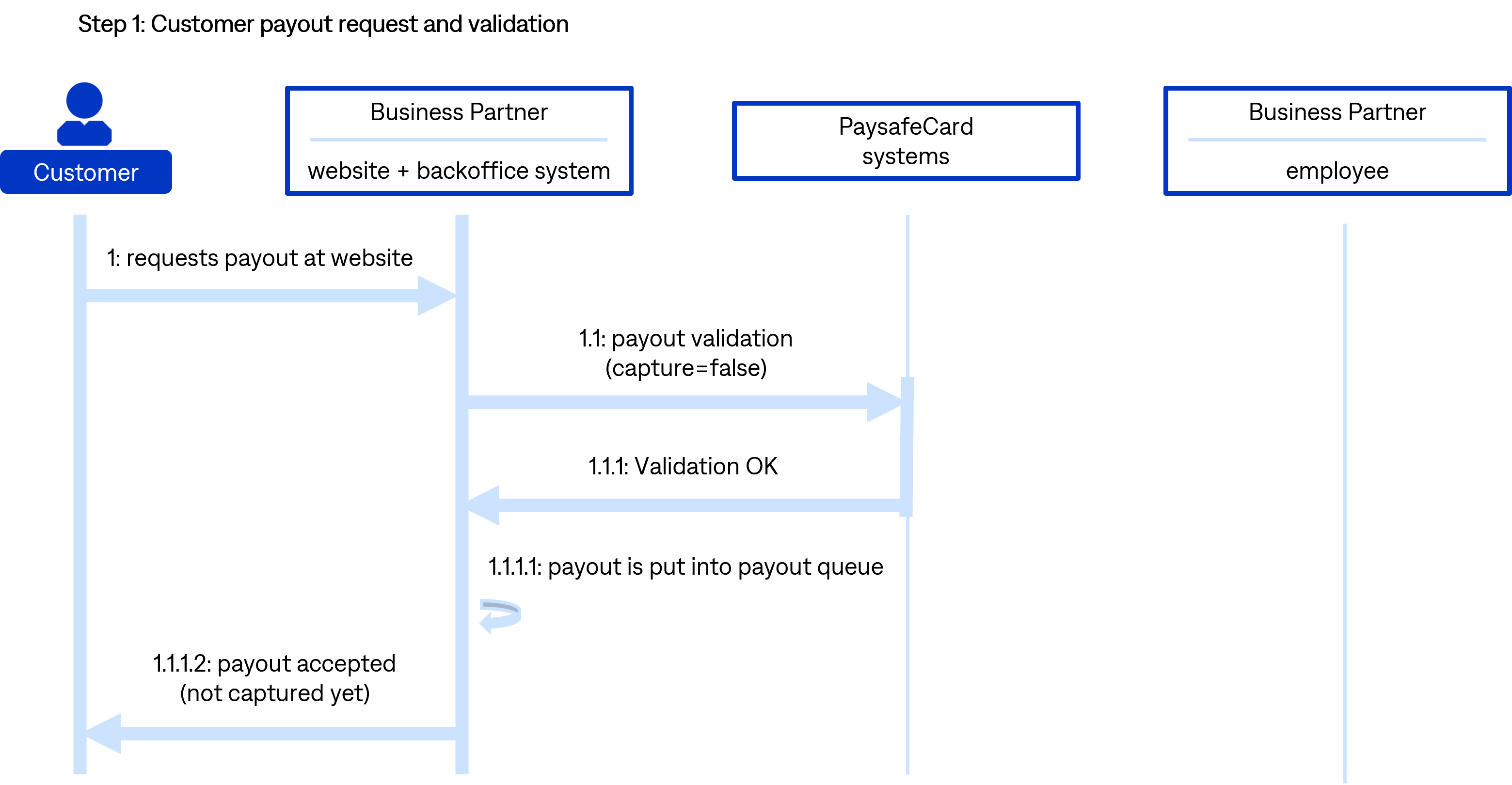
Step 1: Customer Payout Request and Validation
1. Customer requests a payout on the merchant’s website.

1.1 Payout request validation
The business partner validates the payout request in real time by sending a validation request to the PaysafeCard system (`capture=false`). At this stage, **no funds are transferred**.

1.1.1 PaysafeCard validates the payout request
PaysafeCard checks whether the payout can be performed, including:
- whether the customer exists, and
- whether the payout is generally allowed.

1.1.1.1 Payout is placed in the back‑office payout queue
If validation is successful, the merchant places the payout request into an internal back‑office queue for later manual approval.

1.1.1.2 Customer is informed about the payout status
The customer is notified that the payout request has been accepted and is pending approval. If validation fails, the customer is informed that the payout request was refused.
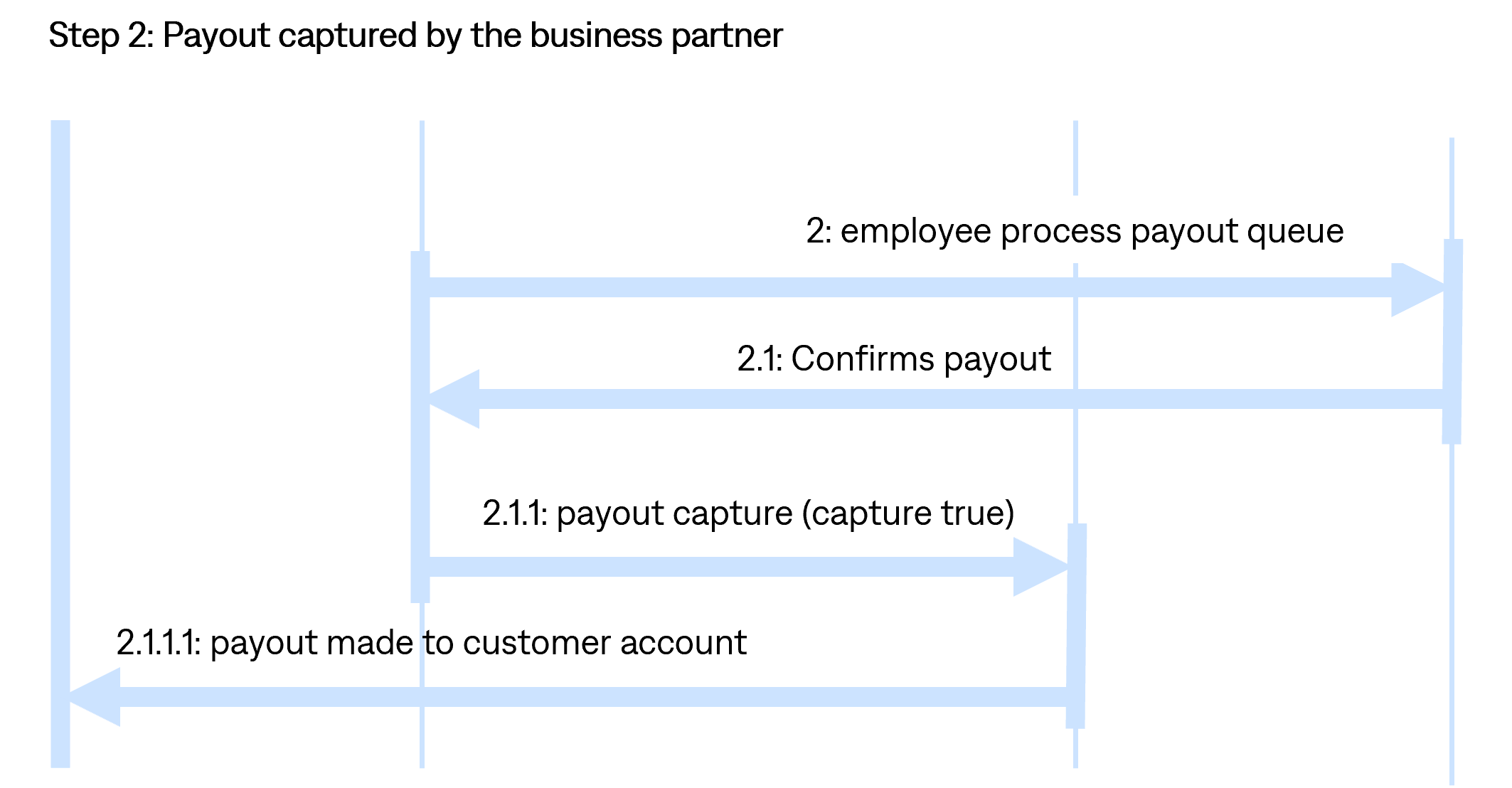
Step 2: Payout Capture by the Business Partner
2. The business partner’s back‑office employee processes the payout queue.
The employee reviews pending payout requests that were previously validated and queued.

2.1 The employee confirms or rejects the payout request.
Based on internal checks and approval rules, the payout is either approved for execution or rejected.

2.1.1 The business partner captures the payout** (`capture=true`).
Upon approval, the business partner sends a payout capture request to PaysafeCard, initiating the actual transfer of funds.

2.1.1.1 PaysafeCard transfers the funds to the customer’s PaysafeCard account.
Once the payout is successfully captured, PaysafeCard credits the payout amount to the customer’s PaysafeCard account.
Customer Data Requirements for Payouts
For each payout request, the business partner must provide the customer’s personal details to PaysafeCard as part of the payout API call.
The following information is required:
- First name
- Last name
- Date of birth
The customer’s first and last name must be provided using the original alphabet in which they are registered (for example, Greek or Cyrillic characters where applicable).
PaysafeCard automatically validates the provided customer data against the data stored in the customer’s registered PaysafeCard account.
If the provided data does not fully match the account data, the payout request will be automatically refused.
Validation Logic
Before validation, the provided input data is normalized by PaysafeCard (for example, to account for formatting differences).
The validation process applies tolerant matching to reduce unnecessary rejections caused by minor deviations (such as small spelling differences).
If the provided data falls outside the acceptable matching tolerance, automatic validation cannot be completed and the payout request will be automatically refused.
If the customer data cannot be validated successfully against the registered PaysafeCard account data, the payout will be rejected.
Retrieve MID Limits
Each business partner is assigned one MID per currency.
Each MID has an associated payout limit, which defines the maximum amount that can still be paid out by the merchant for the corresponding time period.
The current financial status and remaining payout limit of an MID can be retrieved in real time using the REST endpoint: /payouts/limits/currency
If the business partner has multiple MIDs, all associated MIDs will be returned automatically when no currency is specified in the request.
Limit Exhaustion
As soon as the payout limit of a specific MID is reached, no further payouts can be executed on that MID for the current time period.
This payout‑limit information is also available through the Merchant Service Center (MSC) web interface. However, the MSC only displays the payout state of the currently selected MID and does not include information about other associated MIDs.
For a complete overview of payout limits across all MIDs, use the REST API rather than the web interface.
The payout report
For reconciliation purposes, the business partner can download a payout report in CSV format.
The payout report contains comprehensive information covering both payments and payouts, enabling accurate reconciliation and financial tracking.
The report can be downloaded via:
- the Merchant Service Center (MSC) web interface, or
- the Settlement Report API for automated retrieval and integration into downstream reconciliation processes.
Settlement and Netting of Payouts
All payout transactions are funded by the business partner.
The total payout amount for a given month is automatically deducted (netted) from the total monthly payment amount during settlement.
Payouts Exceeding Payments
The total payout amount may exceed the total payment amount up to a defined limit, evaluated and assigned by our risk team.
You can retrieve the current MID limits as described in the Retrieve MID Limits section.
The Retrieve MID Limits option provides detailed information about how much payout volume is available, including scenarios where payouts exceed incoming payments.
Payout Implementation
The technical and operational prerequisites for integrating payouts are the same as for the standard PaysafeCard payment API.
This includes, but is not limited to:
- API authentication using credentials provided by PaysafeCard
- Network access and IP allow‑listing for the PaysafeCard payment servers
- Correct HTTP headers (for example
Content-Type: application/json; charset=UTF-8) - Access to a PaysafeCard account for testing purposes
Payout functionality is implemented on top of the existing PaysafeCard payment API.
Before integrating payouts, the standard payment flow must already be fully implemented and operational.
Interface Guidelines
From a customer‑experience perspective, the recommended implementation of PaysafeCard payouts is documented in the following guide:
Interface GuidelinesAll required error messages described in the Interface Guidelines must be implemented as specified.