Merchant Client ID (MCID)
Also referred to as the Customer ID, the MCID is a key parameter for integrating PaysafeCard.
The MCID uniquely identifies a customer on the business partner’s side and is used to associate all transactions performed by that customer.
For optimal results, the MCID should be a completely random value that uniquely identifies the customer while remaining fully disconnected from any personal or sensitive information.
The same MCID must be used consistently across all transactions associated with a given customer.
Some guidelines for Customer IDs can be seen below
Valid Values:
| Value | Type |
|---|---|
2c3be0b50c7a5f1964a63d78f38a6ffc41c027e9 | SHA1 - test@123.com |
742f2b1a55cd5d606ea44b4fcb54646a | MD5 - test@123.com |
3a5b0d0777dead9df93d502df85c8180e53804eb | SHA1 - UsernameValue1 |
3192481752123 | Random Customer Identifier |
CustomerID1 | Customer Identifier free of personal information |
Invalid Values:
test@123.comUsername_1FirstName123LastName123TimestampIP Address
Submitting invalid values is not permitted and will result in the request being rejected.
Importance of the MCID parameter
Below you will find additional important information on MCID.
Background and Explanation of the MCID
For a given MID/RC combination (for example, MID 1000000098 with RC = NULL), each customer must be represented by exactly one MCID.
The MCID uniquely identifies a customer on the business partner’s side and is used to associate all transactions with a specific merchant account.
How MCIDs Are Interpreted
The following logic applies on our side:
- Multiple transactions (2, 3, 4, …) using the same MCID represent a single customer using the same merchant account for all transactions.
- Multiple transactions using different MCIDs (2, 3, 4, …) represent multiple customers, each using their own distinct merchant account.
Important
It is critical that the MCID provides a correct and consistent representation of customer accounts on the business partner’s side.
Each recurring merchant customer must always use the same MCID when initiating transactions or requesting payouts from the same merchant account. This establishes a strict one-to-one relationship between a merchant account and its MCID.
Examples:
- Merchant Account X must always use MCID X
- Merchant Account Y must always use MCID Y
- Merchant Account Z must always use MCID Z
This mapping must remain consistent for all transactions initiated or requested from each merchant account.
Every new merchant customer must be assigned a new, unique MCID.
What Does This Mean for Payouts?
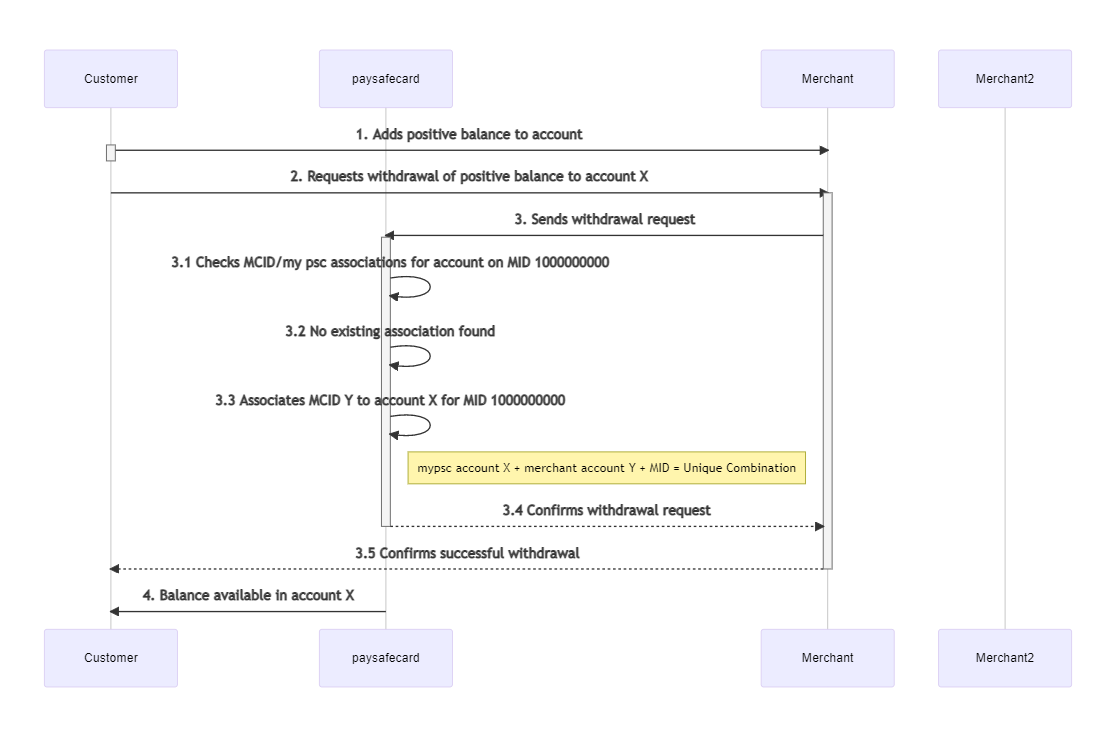
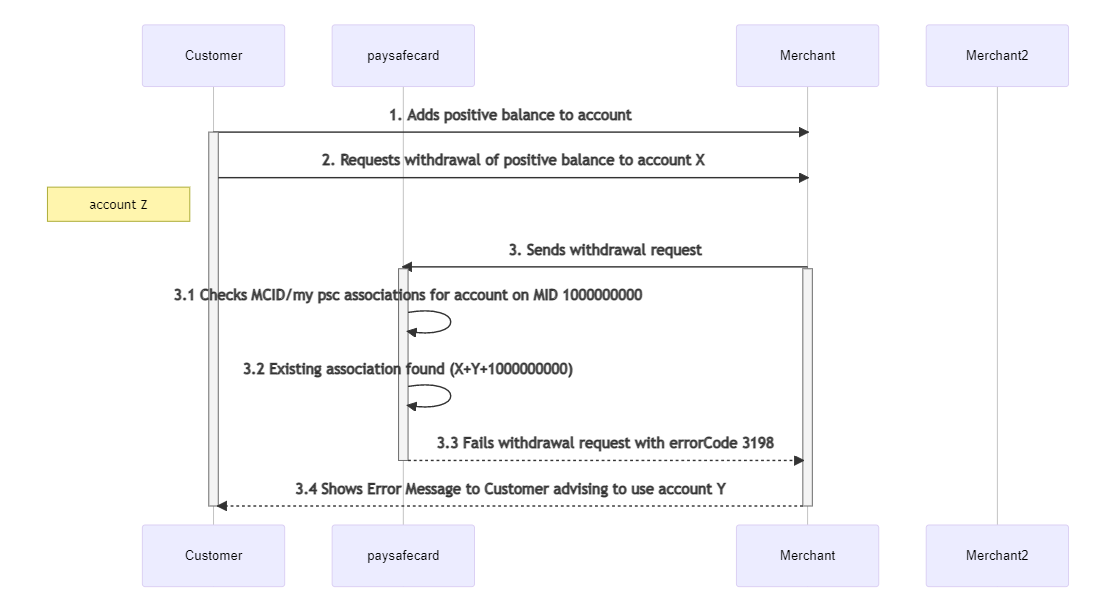
The first payout creates a binding association between an MCID and a PaysafeCard account for the respective MID/RC combination. All subsequent payouts must follow this established association.
For example:
- Every payout initiated by Merchant Account X must be requested using MCID X.
- MCID X becomes associated with PaysafeCard Account X.
- From that point onward, this association is enforced in both directions:
- All payouts for PaysafeCard Account X must be requested using MCID X.
- All payouts requested using MCID X must be made to PaysafeCard Account X.
Maintaining this consistency is mandatory for correct customer identification and payout processing.
MCID error flows
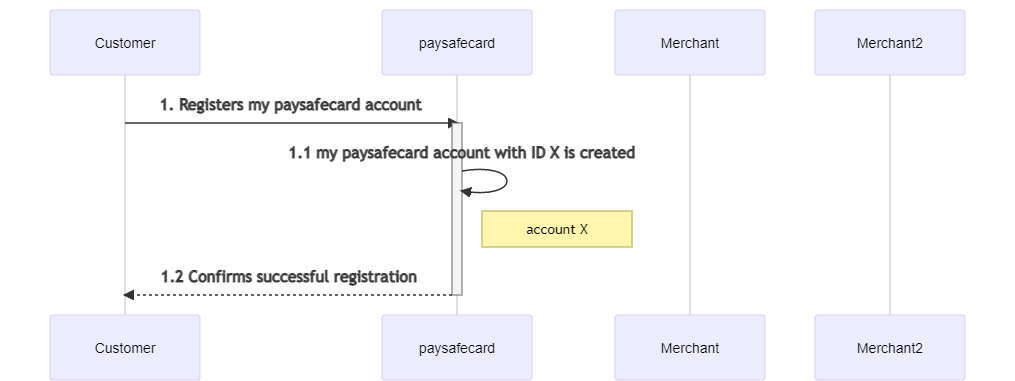
Customer creates PaySafecard Account X:
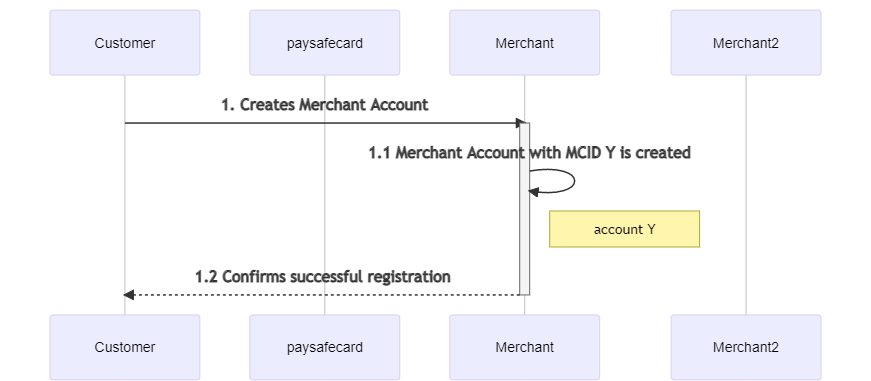
Customer creates Merchant Account Y:
Customer requests withdrawal of Merchant Account Y to their PaySafecard Account X(successful flow):
Customer creates Merchant Account Z:
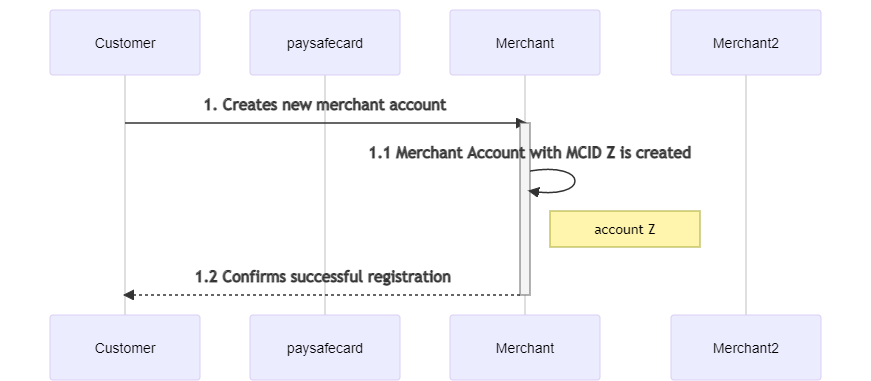
Customer requests withdrawal of Merchant Account Z to their PaySafecard Account X(failing flow)
| Code | Number | HTTP Status | Description |
|---|---|---|---|
There is already the maximum number of pay-out merchant clients assigned to this account | 3198 | 400 | The MCID does not match with the previously used MCID for that PaySafecard account. We only allow 1:1 relationships for MCID: PaySafecard account. |
Customer creates PaySafecard Account A:
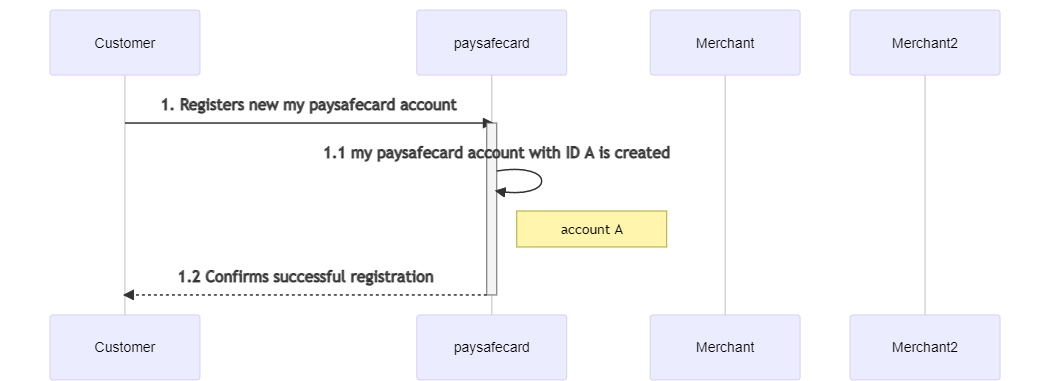
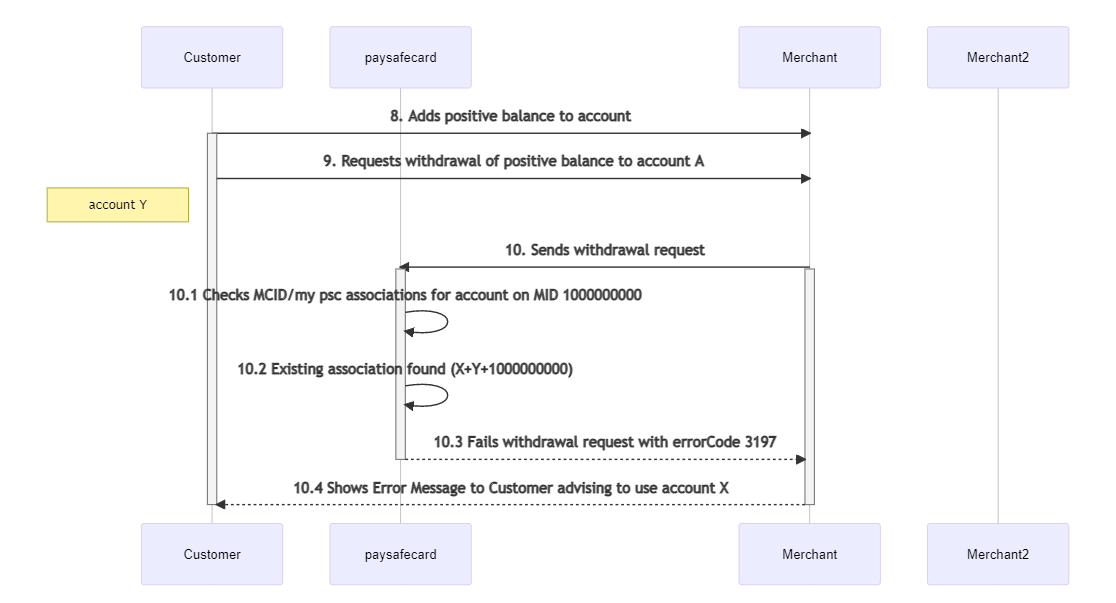
Customer requests withdrawal of Merchant Account Y to their PaySafecard Account X(failing flow)
| Code | Number | HTTP Status | Description |
|---|---|---|---|
There is already the maximum number of pay-out accounts assigned to this merchantClient | 3197 | 400 | The PaySafecard account does not match with the previously used PaySafecard account for that MCID. We only allow 1:1 relationships for MCID:PaySafecard account. |